Showing posts with label Tallinn. Show all posts

Wednesday, October 9, 2013

Completing the Circle of Estonia (Part 3 of 3)


The sun sparkled as we drove south from Võru and up a gentle slope to Big Egg Mountain, the highest point in Estonia and, well, more like a subdued hill. From the top we looked upon a rolling landscape of forest with patches of farmland.

At our next stop, the Võru Museum, we were the only visitors, a reminder of how peaceful the tourist path is away from Tallinn. The museum was grim, mostly about wars. I was drawn to a bunker where the Forest Brothers lived while they fought guerrilla 

warfare against the Russians following World War II.

We often visited cemeteries to enjoy the greenery and listen to the stories the stones tell. At Elva, I visited the graves of my maternal grandparents wishing we had gotten to know each other.
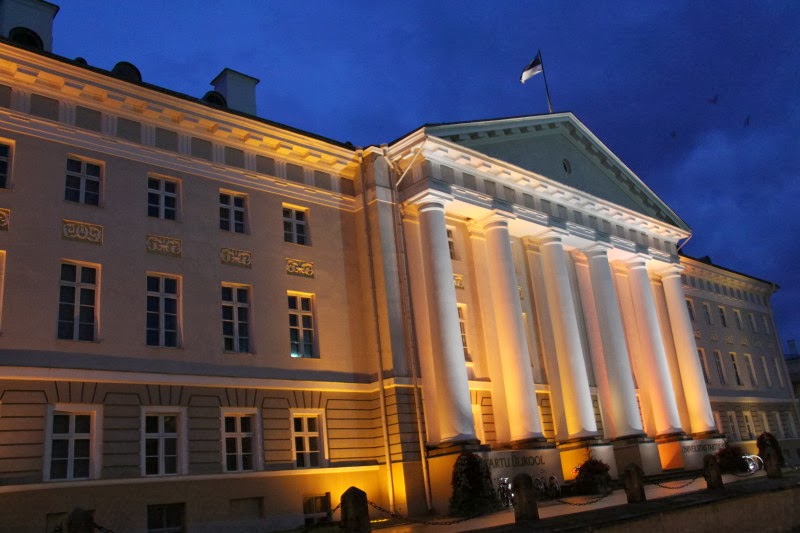
Then we were in Tartu (population 105,000) and could feel the vibrancy of a university city. We set off on a walking tour. At the main square, a regal town hall loomed over a cobble-stoned square lined by outdoor cafes. Statues proliferated and we particularly enjoyed the bronze Oscar Wilde and Eduard Vilde casually chatting. Then we were on Tartu University (established 1632) campus, which is heavily treed. Especially impressive was the History Museum located in the majestic ruins of a cathedral dating to the 13th century. Then we came upon the main university building with its dominating six tall Doric columns. Soon we were in 14th century St. John’s Church with its almost 1000 terra cotta figurines. An orchestra was rehearsing, a reminder that Estonians love music and that the peaceful Singing Revolution helped the country gain its freedom.

After two wonderful days we departed Tartu. At a tiny village we bumped aboard an old one-car barge and were hand-winched across the Ema River. Estonia is a delightful mixture of old and new!

Driving north along the shore of Peipsi Lake, we passed through small villages where old ladies sold onions and smoked fish by the roadside.

We arrived in Narva (95% Russian population) under dark ominous skies. The border crossing to Russia had long line-ups and menacing barbed wire. Narva castle is well preserved and, surprise, only a short cannon-shot across Narva River in Russia is the almost identical Ivanogrod Fortress.


I photographed Lenin’s statue in an out-of-the-way corner of the castle grounds and learned that strong Russian pressure had prevented its consignment to the scrap heap after independence. The large Russian population in Estonia (25%) is certainly awkward. We were happy to head westward.

In Rakvere, the Aqva Spa Hotel included an extensive indoor water park, saunas, a spa and lap-pools, which were packed. I entered the sauna, where I sweated in the semi-dark, enjoying Estonian voices and the slapping of birch twigs against skin. In the morning we visited Rakvere Castle and then drove westward.

Estonia is dotted with hundreds of manor houses, but none is finer than the baroque Palmse Manor in Lahemaa National Park. We wandered around its extensive, immaculate gardens, marvelling at the rich elegance, a contrast to the surrounding rural area.

A short drive took us to pretty Käsmu on the Gulf of Finland, which has many trendy summer homes. I walked along the shore, thinking of my mother who escaped, pregnant with me, from a cold shore like this in a crowded small boat as the Russians invaded.

That evening, I nursed a dark beer in Tallinn. I had learned that Estonia is about history and people. It was heart-warming to meet relatives, and satisfying to see Estonia blossoming after 50 years of repression. I regretted not having visited earlier.


If You Go
Aqva Spa Hotel, Rakvere:  www.aqvahotels.ee/en
Hotel London, Tartu:  www.londonhotel.ee/en
General information: www.visitestonia.com/en/
Impressions of Estonia, useful book with 124 photos:

 www.blurb.ca/bookstore/detail/3850029

Wednesday, October 2, 2013

Circling Estonia (Part 2 of 3)

We left Tallinn and headed southwest toward Pärnu, the start of our counter-clockwise trip around Estonia. We drove from one historic spot to another following the ubiquitous brown signs pointing to historic/cultural sites. Thanks (or curses) to its strategic location, Estonia has long been fought over and, thus, has an enormous number of castles, fortifications and other ruins.

Our first stop was Padise Monastary, whose construction began in the 13th century. It had a vaulted church and was fortified, but had fallen into ruins. There was no entrance fee and a large sign provided a detailed history.

We meandered along back roads. There was little traffic, the signage was good and there were virtually no billboards nor litter. It was peaceful and restful.

The steepled church at a small village beckoned. The cemetery was beautiful. A monument to more than 100 people massacred by the Russians gave an insight into the sad decades of oppression that Estonia suffered.

With “Agnes” (our Estonian-speaking GPS) giving directions, we drove through a flat landscape with birch forests, wetlands and occasional farms and villages.

We arrived at Pärnu, a popular sea-side resort with a long sandy beach, many parks and a rich cultural life. However, at the end of September a cool wind blew along empty streets. The town centre featured a walking promenade and, delightfully, no big chain stores. At a small, back-alley restaurant, we enjoyed a cheap, tasty meal while a chess game was contested at the next table.

Next morning the breakfast table was elegantly adorned with a fresh rose and candles in pewter holders. Omelettes were followed by Estonia crepes — one of my childhood favourites!

We drove leisurely toward Saaremaa, Estonia’s largest island. The ferry was cheaper, more efficient and more comfortable than those plying Canada’s west coast.

We wandered around Koguva village, a national heritage fishing village with moss-covered stone fences, log buildings and thatched roofs. My camera clicked constantly.

The highlight of Kuresaare, Saaremaa’s capital, was the castle, the best-preserved medieval (14th century) stronghold in the Baltics. A small exhibit dedicated to the Estonians murdered by the Soviets in 1941, brought tears to our eyes.

Next morning, we headed toward Võru, passing wooden houses and remnants of the Soviet-occupation days: deteriorating apartment blocks and large abandoned collective-farm buildings. A small detour led us to Karski Fortress (1248) along with its pretty Baroque church. Wildflowers bloomed alongside the ruins.

Motoring eastward, the countryside became rolling and more forested. We popped into Valka, Latvia. There was no border stop, just a sign. Latvia looked the same as Estonia except the signs and names were incomprehensible.

Nearing Võru, “Agnes” led us to the farm of my cousin, Matti, whom I had never met. His family greeted us with open arms and sat us down to a hearty farm meal. They spoke no English but we managed quite nicely, aided by a few glasses of Vana Tallinn, a liquor they explained was more valuable than money during the occupation. Then we visited the neighbouring farm, now abandoned, where my father grew up. I was moved.

Finally we arrived at the Kubija Hotel-Naturespa, south of Võru where roller-bladers and runners raced along forest trails. Erki Nool, the legendary gold-medallist in the decathlon at the 2000 Olympics, trained here and the lobby boasts a statue of him pole-vaulting.

If You Go
- Villa Wesset Hotel, Parnu:  www.wesset.ee
- Kubija Hotel-Naturespa, Võru:   www.visitestonia.com/en/kubija-hotel-nature-spa
- General information: http://www.visitestonia.com/en/
- Impressions of Estonia, useful book with 124 photos: www.blurb.ca/bookstore/detail/3850029

Connecting with My Roots in Estonia (Part 1 of 3)

Although I’d never been to the homeland, I grew up speaking Estonian. But I was always reticent to visit my homeland. Finally, I decided to go.

Entering the medieval Old Town, I was overwhelmed with emotion for Tallinn is one of Europe’s most beautiful capitals with narrow cobblestone streets, church spires, medieval buildings, thick battlements and towers.

Over the next two days my dearest, Allyson, and I
walked and walked, immersing ourselves in the glorious Old Town, which was established in 1219 by the Danes. The town is surprisingly well preserved given the wars that Estonia has suffered. At the centre is the town hall square, which is dominated by a Gothic town hall (1404) and lined with bustling open-air cafes. Patio umbrellas carried the name Saku (the local beer). Throngs of tourists milled in the square for Tallinn is a regular stop for cruise ships.

The Old Town, a UNESCO World Heritage Site, is actually two towns, each with its own fortifications. The upper one was for nobles and the lower town for merchants. About 2 kilometres of sturdy stone walls and 27 towers are still preserved.

The ramparts of upper Town offer wonderful views onto the rooftops and spires of lower Town. We visited the parliament buildings, the Russian Orthodox Alexander Nevsky cathedral and Pikk Hermann tower, which reminded me of the Estonian flag holder in my parents’ home long ago.

The lower town is full of museums and churches. I particularly enjoyed the Passage of History where plaques in the sidewalk outline Estonian history from 1154 to the present.

Next day, our guide pointed to a stately Gothic house. “That was the former KGB headquarters,” she said. “This street was the most feared place in the city.” As we were to learn, Russia still casts a dark shadow over the land.

Our local haunt became the Hell Hunt bar, on whose window a smiling wolf carries a naked blonde lady.
The beer was delicious and cheap and Allyson and I usually ordered the house light and dark beers. Restaurants and bars abounded for Tallinn has a raucous night life.

My cousins, who I met for the first time, explained that Estonia is a progressive country and has made huge strides since gaining its freedom in 1991. Skype was invented here; there is almost no government debt; Estonia is a member of NATO and the Eurozone; and voting is conducted via Internet. I was proud.

We visited Seaplane Harbour, a brand-new, must-see maritime museum just outside the Old Town. The main building is an immense dome, originally built in 1917. Inside, it is surreal and contains a submarine, the oldest boat in Estonia and much more.

On the fourth day, we rented a car and set off to circle the country. We were entering terra incognita for tourists rarely venture outside Tallinn.


If You Go
Meriton Old Town Hotel:  www.meritonhotels.com
General information: http://www.visitestonia.com/en/
Impressions of Estonia, useful book with 124 photos:
 www.blurb.ca/bookstore/detail/3850029